OFFER: A BRAND NEW SERIES AND 2 FREEBIES FOR YOU!
Grab my new series, "Western Hearts United", and get 2 FREE novels as a gift! Have a look here!
Chapter One
Salina, Kansas
Autumn 1867
Just two days ago, Sawyer Drayton’s life had been intact.
Now, he was sitting in Doctor Clark’s office, trying to make sense of what was going on while he waited to find out if his eight-year old son was all right.
He’d found two bodies on his ranch in less than twenty-four hours.
A dead stranger had been discovered on the Drayton ranch yesterday. Sawyer was a suspect in the murder of a man whose identity and existence were unknown to him. The thought rose in Sawyer’s thoughts like a weed breaking through garden soil: Did the sheriff have the wrong Drayton brother in mind for the crime?
The other, Milo Drayton, unconscious but alive, had gone in search of his missing dog. His horse had come back with no one in the saddle. Milo was a good rider. What had caused him to fall from his horse?
Sawyer hadn’t felt such turmoil in years. Eight years, to be precise. He’d been twenty-five then, married and anticipating fatherhood. There was no way to have predicted that he would be widowed longer than he’d been married.
Sawyer’s mind took him back in time. His newborn son in his arms, his wife lying dead on the bed. Love that wrenched his heart and grief that clung to the new life.
Now, Sawyer sat outside Doctor Clark’s surgery and waited, just as he had waited eight years ago. Waiting. Minutes turned to years. Milo, his son, motherless. Growing up to resemble Clara, the mother he would never know. Sawyer saw the images of the past as if his son’s life had been captured by Mathew Brady’s photography.
Sawyer brushed his tousled dark brown hair away from his forehead. Cynthia had just given Milo’s hair a trim earlier that week, and she’d been threatening to take her pruning shears to Sawyer’s mop if he didn’t get himself off to Barber Otis before Sunday. Milo had enjoyed Cynthia’s threats, chortling with mirth at the image of his father’s locks being hacked off by Cynthia’s gardening tools.
“I can’t lose him.” Sawyer didn’t realize that he’d spoken aloud until Cynthia’s hand pressed against his arm.
“Milo is a healthy lad,” Cynthia said in her emphatic way.
His friend was middle-aged and comfortably in her fifties, stalwart and loving; she had knitted the devastated, newly widowed father and the infant son into a family of two. During those desolate months after Clara’s death, when Sawyer’s sole reason for rising in the morning was because of the son she had borne, it was Cynthia who had maintained the household.
She had been there when Sawyer and his older brother, Severin, were younger, and she had been with Sawyer today, holding Milo’s unconscious body in her arms while Sawyer drove the wagon to the doctor.
“What was he doing out there?” Sawyer asked again. It was a rhetorical question because he knew that Britta, the dog, was missing, and Milo had gone to find her. When Milo’s horse came back to the ranch riderless, Sawyer and his ranch hands had gone out searching.
By that time, the body of the dead man had already been found, although Sheriff Cromwell was unwilling to part with much in the way of details. The two incidents, separated by time, could not be connected, and yet Sawyer couldn’t help but link them.
“He’ll tell you when he comes to,” Cynthia said. “He’s a boy on a ranch looking for his missing dog. He most likely planned to scour all two hundred acres to find Britta. Maybe something spooked the horse, or Milo thought he saw something, dismounted to look at it, and…We don’t know, Sawyer. He’ll tell us more when he comes around. He will come around.”
Sawyer nodded. But eight years ago, when Clara had gone into childbirth, everyone had assured him that she would be fine. Until she died.
Cynthia had no doubt that Milo would be well. But seeing his son’s motionless body sprawled beneath the spreading foliage of the black walnut tree where Clara, nine years ago, had told Sawyer the happy news that she was with child seemed to sever Sawyer from hope itself.
Now he waited. Cynthia waited with him, her confidence as strong as his apprehension.
The surgery door opened, and Doctor Clark emerged, wiping his hands on the surgical apron that he wore.
“It’s a blessing he was unconscious,” the doctor said without preamble. “I had to reset many a bone in the war, and I saw grown men cry for their mamas when I did. He’s got a broken wrist, and he won’t be climbing trees until the bone knits back together. But knowing that boy of yours, he’ll be trying to get back on his horse even with his arm in a sling. Keep him quiet for a spell, though.”
“Why?” Sawyer asked quickly. “What’s wrong if he just has a broken wrist?”
“You said you found him on the ground,” Doc Clark explained patiently. “He likely took a fall. He could have a commotion cerebri. A concussion,” the doctor elaborated at Sawyer’s blank expression. Rest is what he needs. He’ll be fine.”
Sawyer, who had risen to his feet as soon as the door opened, grabbed Doctor Clark’s hand and pumped it up and down in gratitude. “Thanks, Doc. I’ve been out here with nothing to do but worry and wait all this time.”
Dr. Clark’s gray eyes showed a sympathy that was generally concealed beneath his thick red beard and stern visage. “I reckon you have,” he said. There was no need to elaborate; he had delivered Milo and broken the news to Sawyer that his son was born and his wife had died.
“I’ve mixed up a powder that will help some with the pain. Keep him quiet for a few days. Give the bone a chance to heal. But see that he eats beef. Beef,” the doctor repeated. “He won’t be hungry today, but try to get some beef broth into him at least,” he directed this comment to Cynthia. “When he’s stronger, you can give him chocolate cake three times a day if you want to.”
Sawyer hadn’t smiled since his son’s horse showed up without Milo in the saddle, but he was smiling now. “He’ll get that cake,” Sawyer vowed.
“That’s right,” the doctor recalled. “You take to baking about as well as you take to ranching.”
“Sawyer bakes better than I do,” Cynthia agreed. “He used to bake with his ma when he was a young’un. You remember those days, Sawyer?” she asked him.
Some of the happiest days of Sawyer’s early years had been spent with his mother and a rolling pin. His father had disapproved of Sawyer’s penchant for baking, and his brother, Severin, had been downright derisive regarding the time that Claudia Drayton and her youngest son had spent in the kitchen.
Only the fact that Sawyer mastered horsemanship from an early age and showed an affinity for ranch work that eluded his older brother kept Severin Senior from forbidding his son the indulgence in such an unmanly pastime.
“I sure do,” Sawyer said fervently. “Learning to make a pie crust that met Ma’s approval was nigh as proud a moment for me as when I sat in the saddle for the first time. Can I take him home now? Milo?” Getting his son home was paramount in Sawyer’s thoughts.
“Sure can.”
“You carry your boy,” Cynthia said with fondness. “I’ll manage the reins going home.”
Sawyer wrapped Milo in the blanket he kept in the back of the wagon. He held his son close to him, the little boy’s slender body stretched out upon Sawyer’s lap, held tightly in his arms. The days for holding his child in his arms were rare anymore; Milo was conscious of the dignity of an eight-year old boy, and Sawyer didn’t intrude.
Cynthia handled a horse as efficiently as she did everything, and Jonquil, accustomed to her hand on the reins, kept a measured pace.
Cynthia looked over at Sawyer and his son and smiled. “It’s good to see a man who shows affection to his child.”
She didn’t offer background on her remark, and she didn’t need to. She had seen for herself how aloof Severin Senior was with both his sons. Sawyer hadn’t realized how much he and his brother had lost by being the sons of a man incapable of demonstrating affection until he’d held his own son in his arms. It was then that he’d experienced a sense of peace that nothing else could have delivered.
“I don’t reckon he’ll let me do it for much longer,” Sawyer confessed. “He pays a heap of attention to what the other boys say.”
“Severin always did, too,” Cynthia recalled. “You didn’t mind what others said back then. You took a fair amount of teasing for how much you liked spending time with your ma in the kitchen, but you didn’t let what they said stop you from doing it.”
A tired grin brought momentary humor to Sawyer’s wind-weathered face. “I gave Clyde Peabody a thrashing over it, though. I brought Miss Putnam a cake I’d made all by myself on the last day of school. Clyde called me a sissy. On the way home, I made him take back those words.” His grin faded. “I don’t want Milo to have to brawl to stand his ground. But I want him to know how to do it.”
“Just go on being the pa that you are to him,” Cynthia advised. “If you’re sure of him and he knows it, he’ll draw strength from that.”
At thirty-three years of age now, the trials of being a student in the third grade seemed distant. It had been his mother from whom he’d drawn strength, though, Sawyer thought.
He brushed a lock of Milo’s flaxen hair, so much like Clara’s, away from the boy’s forehead. The distance between the brothers had grown wider after Sawyer married Clara. He wasn’t sure why. Severin had always been more interested in business than in family.
Would Severin have grown up to be a different kind of man if he’d drawn the same kind of affirmation from their father that Sawyer had derived from their mother? It would have warmed Sawyer’s heart if he and Severin could have had a real brotherly bond.
But even after their parents died and the two brothers only had each other for kin, Severin didn’t show an interest in family ties. Severin had never shown any interest in Milo, even though Sawyer’s son was the only nephew Severin had.
Severin was a mystery to Sawyer. He had no interest in ranching, yet resented the fact that their father had left the ranch to the younger son, who did. As the mayor of Salina, Severin had his fingers in every political pie that Kansas offered, and he looked the part. As tall as Sawyer, but with a clean-shaven, tailored appearance markedly different from the stubble on his younger brother’s face and Sawyer’s rumpled clothes and battered boots, the older Drayton son was a striking contrast to the younger.
Cain and Abel, Sawyer thought as the wagon pulled onto Drayton land. At least he hasn’t tried to kill me.
***
“Hey, Sawyer, how’s the boy?”
Tom Whatley, the ranch foreman, appeared from behind the barn.
“Doc says it’s a broken wrist, but he’ll mend fast.”
Tom nodded as if this were welcome news. “I can’t think what must have knocked him off his saddle,” he said, puzzled. “The boy has a good seat, always has had.”
“When he wakes,” Sawyer said, more confident now than he’d been before the doctor had spoken, “he’ll tell us more.”
“Tell him he sure got us all scairt. Even Severin.”
“Severin?” Sawyer shifted Milo in his arms. “Did he come by?”
“Sure did,” Tom affirmed. “He brought by some flowers for Milo.” Tom’s sunburned face cracked a grin. “I don’t know that an eight-year old lad who likes horses and dogs has much truck with flowers, but I brought them into the house and set them in that milk pitcher on the table.”
“Severin?” That didn’t fit. Sawyer didn’t mask the disbelief in his voice. “Severin brought flowers for Milo? How did he know about Milo being hurt?”
Tom shrugged. “Severin knows everything that goes on in Salina,” was his simple explanation. “Some say he knows everything that goes on in all of Kansas.”
That was true. Severin’s political connections in Salina had their own links to people in other parts of the state, even as far as Abilene. Politics held Severin’s attention. Family didn’t. Sawyer thanked his foreman and went into the house.
“I’ll sit with Milo awhile,” Sawyer told Cynthia before taking his son upstairs to his bedroom. “He’s likely to be scared when he wakes.”
“I’ll get started on that broth Doc Clark advised,” Cynthia said, crossing the front room where coats and boots were kept and turning toward the kitchen.
Sawyer laid Milo gently on top of his bed and then pulled the folded-down quilt up around his son’s shoulders. It was a pleasant autumn day, but there was still dampness in the air from the fall rains. Good for the garden, he thought automatically, for even though he was a rancher, the land produced the food that fed them, and the harvest season wasn’t yet over.
He went to the fireplace and soon had a warm fire going. Then he returned to Milo’s bedside, pulling a chair close so that he could sit near his son and offer whatever comfort his presence might provide.
But for Sawyer, comfort was lacking. Something was out of joint, and Sawyer wasn’t sure what.
Flowers for Milo from Severin? Severin had never even thought to give Milo a birthday gift. So why flowers now? He’d never shown warmth to anyone but Clara. There had been a time when Sawyer had wondered if Severin—but no, that was daft. Severin liked money, power, and influence. Kind-hearted Clara, the schoolteacher, was not the kind of wife who could have advanced Severin’s political career.
Daft to think those things. But there wasn’t much sense to be had in any of Sawyer’s thoughts just now.
Disquieted, Sawyer thought back to the conversation he’d had with the sheriff just the day before. Sheriff Cromwell had stopped by the ranch with disturbing news.
“A body was found on your property,” the sheriff had said after Sawyer answered the door. “I’m investigating it. You’ll need to stop by my office this afternoon so I can take your statement.”
“Statement for what? If a body was found on my land, this is the first I’m hearing of it, and I guarantee you, one of my men would have let me know before you came to tell me.”
“You’re a suspect,” Sheriff Cromwell said. “Don’t let the grass grow under your feet. I want that statement this afternoon.”
But when he’d shown up at the sheriff’s office as directed, the circumstances were no clearer. Sheriff Cromwell offered no details as he told Sawyer that he was the chief suspect in the investigation.
It was all too absurd to be credited, but the lawman’s face was stern. Sawyer had given his account of how he’d spent his day.
Working, like every other rancher.
No, he hadn’t noticed any strangers on his property, but he had two hundred acres, and he didn’t ride over every single one every day.
You’re welcome to talk to the men. Tom, Buck, Clayton, Silas, you know every one of them. They’ll tell the truth.
He didn’t think the sheriff had interrogated the men yet, though. Tom would have told him if he had.
The men knew their boss wasn’t a killer. Sawyer put more trust in them than he put in the sheriff. Or in Severin, his own brother.
Milo’s eyelids fluttered, and Sawyer left off with his grim thoughts. “Hey, pardner,” he said softly.
Milo opened his eyes. “Pa?” he asked, sounding doubtful.
“Last time I checked, that’s what I answer to. How you feeling?”
“Why am I in bed?” Milo asked with a child’s logic. The autumn sun streaming in through the windows told him that it was daytime, not bedtime.
“Don’t you remember?” Sawyer asked, masking his alarm. Why didn’t Milo remember?
Milo tried to sit up, then started to fall back against the pillow. Sawyer put his arm around his son and eased him back down.
“You’re just back from Doc Clark,” he said. “You got yourself a broken wrist there.” He pointed to the sling that supported Milo’s arm.
Recollection dawned in Milo’s brown eyes. Clara’s brown eyes. “I was looking for Britta,” he recalled. “I heard some noise, like a gunshot. But I didn’t see anybody. I didn’t see Britta either,” he added forlornly.
“We’ll search for Britta tomorrow,” Sawyer promised, a lump in his throat at his son’s sadness. “You and me. You’ll have to ride with me, pardner. You can’t handle a horse until that wrist heals. How did you fall off the horse?”
“I don’t know,” Milo looked puzzled. “I don’t recollect falling.” Indignantly, he added, “I never fell off a horse!”
“Never mind.” Sawyer smiled at the resurgence of Milo’s pride in his horsemanship. “You’re all right now, and that’s what matters. Cynthia has some broth cooking for you.”
“I’m not hungry.” Milo’s eyelids closed again. “Just tired.”
“All right, Son. I’ll sit by your side awhile.”
Milo smiled. Clara’s smile.
The smile lingered on Milo’s face as he fell asleep. Watching his son, Sawyer again felt the sting of that unforgotten pain, even as he smiled back at his sleeping son.
He lost track of time as he sat by his son’s bed, but the deepening shadows outside the window told him that daylight was retreating.
As if she, too, had been watching the sun go down, Cynthia appeared at Milo’s bedroom door. She smiled at the boy.
“I’ll sit with him now,” she told Sawyer. “I know you have chores to do.”
“Thanks,” Sawyer said as he left the room.
Cynthia was like a grandmother to Milo, and if he awoke, the boy would be comforted by her presence. Lantern in hand, he left the ranch house and walked to the stable to check on the horses before turning in for bed. He heard the scrape of boots on gravel, followed by a bark.
Lantern held high, Sawyer whirled around. “Who’s there?”
“Just me, Boss, just me.”
“Clayton? You found Britta? That’s the best news Milo could have,” Sawyer said happily as the dog rushed toward him, leaping high with tail-wagging glee at her return.
“Boss, I didn’t find her,” the boy, the youngest of the ranch hands, said, shifting awkwardly from one foot to the other. “I took her.”
Sawyer bent down over Britta’s face to accept the tongue-licking affection of his son’s pet, then slowly straightened. “Took her? Why?”
“I didn’t want to. But Mr. Drayton told me to. He said if I didn’t do it, he’d see to it that Ma would lose the house, and I’d lose my place here. You know the only money Ma has is what I bring in as wages from here. I’m dreadful sorry at what I done, Boss, especially when I heard about Milo.”
Looking up from the dog, Sawyer saw that Clayton was wringing his hat in his hands.
“I took Britta and hid her back in the barn at my place. I knew Ma wouldn’t find out. She don’t walk much these days, and she’d never find the pup in our barn. But I just couldn’t stand it, Boss. I’ll do whatever I gotta do, but please don’t sack me. Ma doesn’t have anything—”
Sawyer put out a reassuring hand while he continued to pet the enthusiastic beagle with the other. “Don’t fret yourself,” he said, keeping his voice level even as thoughts and realizations pummeled him inside. “No one has to know about this but me and you. And my brother. If Severin asks, you can say she must’ve gotten away. You go on back home now. Give my best to your ma. Don’t worry about any of this. Thanks for bringing Britta back.”
The boy bent down to pet Britta. “She sure is a friendly pup,” he said. “I reckon Milo will feel better knowing she’s back.”
Sawyer’s mouth was dry. “He sure will.”
“Boss, what’ll I tell Mr. Drayton when he finds out that Britta’s back?” In the light of the lantern, the fear on the boy’s face was made almost eerie by the shadows. “He’ll be mighty mad at me if he thinks I didn’t keep her from running back here.”
“Don’t you worry,” Sawyer said. “He won’t—he won’t pay any mind.”
The disquiet that had hovered over him earlier when he tried to assemble the shadowy signals circling around him was now settling inside him.
Severin bringing flowers. He’d known Milo was hurt. How?
A dead man’s body had been discovered on the ranch, and without talking to any of the Drayton ranch hands, Sheriff Cromwell had accused Sawyer of murder.
Who was the dead man, and who had killed him?
Whose gun had fired the shot that Milo heard before he fell from his horse?
No answers came from the darkness of the barn. Sawyer didn’t have time to analyze questions that lacked answers. If he stayed in Salina, more death would follow.
***
“Me and Milo are gonna leave by dawn,” Sawyer told Cynthia. “We’re heading to Abilene. I’ve gotta find out what’s going on here.”
“But Sawyer, you heard what Doc Clark said.” Cynthia didn’t hide her worry. “Milo is to have rest. You can’t take him off on a trip to Abilene.”
“I can’t stay here. Something isn’t right, Cynthia. Maybe something has never been right with Severin, but he’s involved in this. I know it. I can’t prove it, but my gut tells me so. Sheriff Cromwell is under Severin’s thumb, and I’ll wager that Milo’s accident wasn’t an accident. I’m suspected of murder, and my son gets spooked off his horse? Milo isn’t safe here.
“Milo will be safer with me than he’d be here if I’m in jail for a murder I didn’t do, and Severin gets guardianship of my son.” Sawyer was speaking so fast that the words didn’t have spaces between them. The sentence came out of his mouth like a long rope. “Pa had a lawman friend in Abilene. I gotta seek him out. I’m not saying that Severin wants the ranch, so much as he wants to take it from me and keep Milo to get control of it after me. I don’t know why, Cynthia, so don’t ask me to explain. If I end up in jail, Milo—”
Cynthia put a reassuring hand on Sawyer’s arm. “If you really think that Milo is in danger, then you must go. I’ll pack Milo’s things,” she said. “I’ll pack up food for you to take. You give me that sheriff’s name, and I’ll send word to you when I can.”
“You’ll stay?” Sawyer said in relief. He didn’t have the right to ask her, but he trusted her.
“Of course I’ll stay,” Cynthia declared, scornful at the thought that she wouldn’t. “You don’t think Severin is gonna scare me off, do you? Besides, if he plans on laying claim to this ranch, he’ll need someone to cook and clean. Besides, Milo will need to know that I’m looking after Britta.”
Sawyer nodded. He could count on Cynthia. She was more like family to him and his son than Severin could ever be.
“I’ll be back,” he vowed. “I might be on the run now, but I’ll be back. This ranch is mine, and it’ll be Milo’s one day. Severin isn’t going to take my son’s legacy from us.”
Chapter Two
Abilene, Kansas
“Grab that parrot! I vow that if she gets anywhere near my cakes, I’ll pluck out her feathers and give them to Hortense Shaw to put in a hat!”
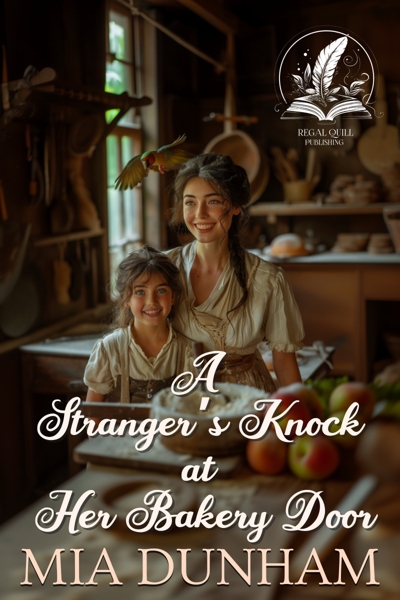
Ivy held out her arm so that her parrot could perch on it, as the parrot customarily did. But Polly rarely conformed to expectations, and she continued to flit above them. Her bright colors made a tropical contrast to the pristine whitewashed walls of the bakery kitchen where Odessa baked the pies, cakes, and assorted pastries that tantalized the local residents of Abilene, Kansas.
It wasn’t bad enough, Odessa thought, fuming, as she flapped her apron up and down against her dress in an effort to drive the bird back to Ivy and eventually her cage, that Gabriel had been an unbearable husband while he was alive. No, even in death, her late husband had found a way to torment her. His gift of the parrot to Ivy, who adored the bird as she had loved her father, extended his harassment beyond the grave.
Polly flew near the bowl of flour that was to be added to the other ingredients waiting on the broad wooden table upon which Odessa worked.
“No!” Odessa shrieked, racing to the table to save the flour, as well as the eggs and butter next to it.
Polly, not at all averse to diving toward a destination, aimed for the white bowl.
Odessa, arms out, flung herself toward it.
Polly missed the bowl in her aerial attack, flying over Odessa, her feathers brushing Odessa’s braided hair, dislodging long, silken brown strands in her flight.
Odessa, running too fast, did not miss the bowl. She plunged against it, sending soft clouds of white flour in all directions. The eggs were covered, the butter crock likewise, and the table was layered in white.
Odessa’s long, dark braid was suddenly white in an acceleration of time far surpassing her twenty-eight years. Her eyebrows were white, as were her eyelashes. The effect, combined with the apron that covered the front of her dress from her neckline to her knees, gave her the appearance of an elderly ghost.
“Mama!” Ivy giggled as Polly, her mischief successfully concluded, took one last flight around the table before she landed on Ivy’s arm and calmly surveyed her handiwork with what Odessa viewed as an expression of smug satisfaction. “You look like an old woman!”
But it was good to hear Ivy’s laughter even if Polly was the cause of it, and so her mother forced a smile on her face.
“Since Polly can’t sweep the floor,” she said, handing her daughter a broom, “I reckon you’ll be helping clean. After you put that infernal bird in her cage. And after you do, you can tell me why you let her out in the first place.”
“Mama, she asked me to,” Ivy said, sounding as though Odessa should have figured that out for herself. “She said to me, ‘I need a walk.’”
“Hmmm,” Odessa replied as she began clearing the table of the flour that had spread across it. “Perhaps your father should have taught Polly to say, ‘I need my cage.’”
“What on earth is going on in here? It looks like it snowed!”
Neither Odessa nor Ivy had heard the back door of the bakery open. Lydia Hawthorne stood there, staring as the flour danced in the air.
“Polly,” Odessa replied briefly.
Lydia, her friend, knew exactly what Odessa thought of Gabriel Galloway and the parrot. Further explanation was not necessary.
Instead, Lydia took the broom from Ivy. “I’ll take that,” she said kindly. “Your ma must think you’re taller than you are.”
While Odessa carefully brushed the flour off the table and Lydia swept the floor, the two former orphans, both now businesswomen in Abilene, moved in a synchronicity born of those early years when they had shared the chores at the orphanage.
Ivy, having deposited Polly in her cage, dampened a cloth and began to wipe the other end of the table where the flour still remained.
Lydia laughed at Ivy’s horrified expression as the flour turned to paste. “That’s a mistake you’ll only make once,” she said calmly. “Flour is superb in crusts and gravies and all sorts of things when you’re cooking. But when you’re cleaning…ahh, not then.”
“But what can I do to help?” Ivy was near tears.
Odessa hurried over to her daughter and embraced her. “You can continue to be the most wonderful daughter a mother could ever have.”
“I’ll agree with that,” Lydia, the mother of twin sons, concurred. “Do you remember, Odessa, when you and I snuck into the matron’s office because we knew that she had peppermint sticks hidden in her desk?”
Odessa put her hand to her head. “Don’t remind me,” she groaned. “I couldn’t sit for a week after the spanking I got from her.”
“You and me both,” Lydia recalled.
Ivy’s tears subsided in fascination at this disclosure. “You got a spanking, Mama?”
“Oh, yes. Matron did love her peppermint sticks,” Odessa said. “We could smell the peppermint on her breath when she would come around to our desks to check on our schoolwork. So Lydia came up with the idea of finding the peppermint sticks and helping ourselves to them.”
“I came up with the idea,” Lydia reminded her friend, “but you were the one who told me that you had seen them in her desk drawer.”
“Yes, well, we were both guilty. We found them in a bag, and we were helping ourselves, but suddenly we heard a noise, and we dropped—”
The bell at the door that signaled a customer’s arrival rang out its cheery jingle. Odessa furiously began to brush the flour from her hair. “I can’t go out there looking like I just rose from a graveyard,” she said.
“Mrs. Galloway.”
Odessa froze. “Mr. Carver,” she greeted Gabriel’s former business associate, standing in the entrance to the kitchen with no warmth in her voice.
Vincent Carver’s assessing eye studied the flour-covered figure of the baker. His lips curled in mirthless humor. “I can’t guess at what recipe you might be working on that requires the baker to be covered in flour.”
“No recipe,” Odessa answered, wishing that she didn’t feel the same ominous sense at his presence that she had so often felt with Gabriel.
“Here,” he told her, handing her a bouquet, the flowers as perfectly arranged as his own attire; nothing out of place, the floral assembly as orderly as his suit. “Might I have a word with you?”
“Just a brief one, I hope,” Odessa forced herself to be civil. “As you can see, I have a great deal of cleaning to do.”
“This will only take a moment. A private word,” he said, his hooded eyes fixed upon her.
“Why don’t you go out into the main room?” Lydia suggested. “Ivy and I will manage here.”
Carver inclined his head in approval. Odessa seethed at his presumption of authority in her bakery, but she followed him out of the kitchen.
“I have unpleasant news,” he began. “Your late husband owed me a considerable amount of money. Obviously, his death precludes payment. Legally, you as his widow would be responsible for those debts.”
“How can that be?” Odessa exclaimed. “This is the first I’ve heard of any debt that Gabriel owed to you.” Her heart seemed to constrict at Carver’s revelation. Gabriel had failed her and Ivy in so many ways. Was this one more way, and was her bakery now in jeopardy?
“I contacted a trusted colleague at the bank and had the debt moved into my account so that I can help you repay it.”
He pulled a receipt from his vest pocket and handed it to her. “As you can see, the matter is being taken care of.”
Odessa looked down at the receipt, but she couldn’t focus on the numbers and words before her. Fear took over her. The bakery was her livelihood, and it was the only way she could provide for Ivy and herself. If she had no means of making an income, what would become of them?
She looked up from the receipt. “I don’t understand!”
He smiled in a patronizing manner, then handed her the bouquet as if flowers could assuage the shock of the receipt. “I’ll explain to you in more detail at another time. I suggest that you allow me to escort you to the church social. After that, we’ll find a convenient and private time to discuss the matter further.”
“Mr. Carver, I’ve been a widow for only eight months,” she said, her voice shaking with anger she tried to conceal. “I cannot be entertaining the attentions of a gentleman so soon after my bereavement.”
“I leave it to you to decide whether or not it’s in your best interests to discuss this unpaid debt, and one of no small amount, as soon as we can do so,” he told her.
He smiled again, a predatory smile that brought to mind the manner in which Polly the parrot had swooped down from the heights to wreak havoc upon her kitchen. But at least Polly had no malevolent intent in mind when she got up to her mischief.
“I bid you good day, Mrs. Galloway,” Carver said and left the bakery.
Lydia appeared as soon as the door closed. “Give me those flowers,” she said hotly. “I’ll put them on the trash heap straightaway! The gall of that man!”
“You heard?”
“Of course I heard,” Lydia responded as she grabbed the bouquet from Odessa’s limp hand. “I was listening from behind the kitchen door where no one could see me.”
“Where’s Ivy?” Odessa asked, the words coming forth from lips that barely moved. Vincent Carver’s visit today, not the first one since Gabriel’s death, had enclosed her in a cage of dread and confusion.
She had learned over the years of her marriage that her husband had secrets. She’d been young when she accepted his proposal, Odessa had matured quickly as she came to the realization that her girlish hopes were based on nothing but foolish dreams. Gabriel had not been a good man, nor was he a good husband. After Ivy was born, Odessa had concentrated on motherhood because, as a mother, she had no conflicting emotions. She loved her daughter profoundly and knew that she would do anything to protect her child.
“Sweeping,” Lydia said.
“What happened to ‘Your ma must think you’re taller than you are’?” Odessa asked.
“She grew, just like that.” Lydia snapped her fingers. “He’s been troubling you, hasn’t he?”
Odessa sighed. She went to the counter where she had arranged a tray of tempting bites of cake to entice customers to buy. Rearranging the morsels, Odessa said, “He comes in more often, and not always to buy anything. I don’t even think he likes cake or pies.”
“I don’t think it’s the cakes he’s coming in for,” Lydia said to her with the blunt honesty that the friends had always employed with one another.
Odessa’s expression was one of dismay. “You can’t mean that!”
“Why not? You’re a beautiful woman, Odessa, even if, just now, you look like a well-preserved grandmother.”
Despite the situation, Odessa laughed. Lydia could always coax her into a better mood.
“But what am I going to do?” she asked. “Gabriel owed him a lot of money. Now that Mr. Carver has taken on the debt, I don’t know what to do. He’s going to expect me to pay it.”
“Then he’ll need to buy a lot more cakes and pies, won’t he?” Lydia’s years as the keeper of an inn had given her a no-nonsense manner of expressing herself.
“He rarely buys anything.”
“Perhaps he’s trying to buy the baker.”
Odessa’s green eyes widened, this time in horror. “You can’t mean—”
“Vincent Carver wants something from you, and he has enough money of his own. He doesn’t need any money from you. But he wants you to be indebted to him. You know that if he took on Gabriel’s debts, it wasn’t out of kindness. I’m not sure Vincent Carver has a heart, or if he does, he keeps his wallet there so no one can reach it. He’s got plenty of money.”
Lydia stood before Odessa, her hands on her hips, with the air of a guardian angel. “From what I hear from my guests, he’s hand-in-glove with the railroad people these days. Railroad people are coming in from all over, and they talk. There’s money to be made there, and Vincent Carver is making plenty. I don’t understand it, but everyone says railroads are the future.”
Odessa looked at her friend in confusion.
“And when that railroad, the one they’re building to connect the East and West, gets finished, there will be plenty of money going around. All I’m trying to tell you is that Vincent Carver isn’t looking for money to get Gabriel’s debts repaid. You need to figure out what he wants from you. It’s not money.”
Odessa met her friend’s gaze. The two had been in the orphanage together, and they had grown up without illusions. Widowhood had confirmed for both the truth, albeit in different ways, that love did not always last a lifetime. Lydia could mourn her late husband with sincerity and speak warmly of him to the twin sons he had fathered. But she was wise and shrewd, and she understood that for Odessa, widowhood had not been a reason for grief.
Until now, when Gabriel’s transgressions no longer lay in the grave with him. Instead, they had risen to life like unquiet spirits, leaving Odessa to find a way to bring peace to the undead debts of Gabriel Galloway. Odessa knew that Lydia only spoke the truth, brutal though it was.
As much as Odessa would have liked to contemplate the prospect of one day falling in love with an honorable man who would be a good father to Ivy and a decent husband for her, she doubted that such a man existed. Vincent Carver was certainly not that man and not a man she would have chosen as a husband, even if she had not been obligated to him for taking on her dead husband’s debts.
“Something will come up,” Lydia said softly, reading the fear in Odessa’s eyes. “You’re not going to marry that man. Why, you’d just as soon marry up with a vulture or a scorpion as wed him.”
Odessa nodded in agreement. She couldn’t bear to think of it now. The kitchen had to be set to rights, and she had baking to do. It was her livelihood. It was also more than that. Now that Abilene had become a center of the cattle industry, the growing town was also the temporary home to brawling cowboys who liked to let off steam after driving cattle on the Chisholm Trail.
With money in their pockets from the sale of the cattle, the cowboys sprawled through the town like ticks, Lydia often said. They liked their beer and whiskey, but they also liked pies and cakes, and Odessa’s bakery was a favorite stop for them before they headed back to the ranches they’d come from. If Odessa’s supply of sweets failed to accommodate their fancy, she feared that they were entirely capable of shooting up the bakery in a drunken spree.
“I have to get back to baking,” she said. “There’s no telling what the Union Pacific will bring in today.”
“Folks say it’ll be called the Kansas Pacific after the line extends from Salina,” Odessa corrected automatically. Rumors about the railroad spread faster than the track was laid, but Odessa paid attention to the talk. As a businesswoman, it was necessary to know what the future held for her and her daughter.
“It doesn’t matter what it’s called,” Lydia said. “It brings us money, but it also brings trouble.”
OFFER: A BRAND NEW SERIES AND 2 FREEBIES FOR YOU!
Grab my new series, "Western Hearts United", and get 2 FREE novels as a gift! Have a look here!
Hello everyone! I hope you enjoyed the preview. Please feel free to share your comments here. Thank you 🙂